The First Flamenco in Samangan
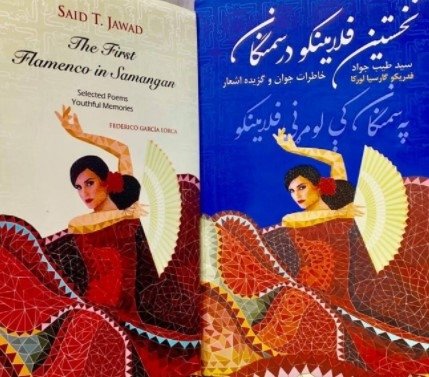
In London, mid 2020, due to the Covid-19 Pandemic, I found some free time to reassemble and edit my translations of a collection of poems by Federico García Lorca. I asked a few poet friends whether I should publish them. They said, “Why not?” I asked, “Would anyone read them?!” They answered, “Probably.”
I have also dusted off my own most recent poems, most of which were originally written in English. Some could not be translated eloquently into Persian. A few poems were born in Persian and adamantly resisted translation into English. And, sometimes the refinement (if any) of the original English poems would have been lost in a literal translation. Hence, they remained largely as born – in English.
Poems with similar themes, whether written in Persian or English, are nevertheless conceptions born of a specific mood, milieu and ambiance. They are, therefore, different creations. I couldn’t bring myself to choose between a Persian or an English translation, or I would be forcing a text to adapt to the tyranny of another language. So, I kept both.
A number of friends contributed to Farsi and Pashto versions of this book. I am very grateful to every one of them. I would like to especially thank my dear friend Adrienne Ross for spending hours reading and editing the English manuscript, my colleague Sophie Drake for her valuable research and work on the first draft, and Alexander Poignant and Hashmat Sarvari for their keen efforts to put the manuscript together.
DOWNLOAD | دانلود به زبان فارسی | په پښتو ژبه کې ډاونلوډ کړئ
Be A Provider of Relief, Not An Inquisitor of Belief
“This is a deeply thoughtful book—one born from the concerns of a genuine intellectual. To discern the secrets, dreams, and afflictions of a nation and to write about them is, as noted, to present serious themes before every seeker of knowledge in Afghanistan—subjects that may serve as guiding models for their future research.
Each of these themes could give rise to numerous debates. In this sense we return to the story of the film Nostalghia: the image of the wise man who carries a fragile candle through a dark cellar, striving to keep its flame alive while carefully bearing it to the other side. For the collective destiny and the collective memory of a people are bound to that small flame and rest upon the steadiness of his hands.
And indeed, as Rudaki has said:
In the midst of harsh trials
Are gained virtue, nobility, and wisdom.
If the severe trials that fate has visited upon us have shaped us in this way, then the lamp that many sages have kept burning with great difficulty for years and centuries must also be kept alight today. In this arduous cellar, Said Tayeb Jawad has fulfilled his share in preserving that light—and continues to do so.”
Seyed Reza Mohammadi
President, Writers’ Union